
How to Get Court Records
Court Administration at the Blue Earth County courthouse is the office behind the local district-court record. It handles certified copies. It also takes questions about restricted files, older case records, and help with the courthouse terminal. For remote viewing, Minnesota Court Records Online, or MCRO, is the statewide layer. It offers the publicly available portion of the Register of Actions, hearings, judgments, and documents. But nothing from MCRO counts as a certified record. So the right channel depends on your goal. A quick public view, an inspection of the original, a plain copy, or certification.
When you don't yet have a case number, start with MCRO Case Search. Once you have the number, its Document Search takes over. Is an accessible file missing online? Use the public-access terminal. Or visit Court Administration at the Blue Earth County Justice Center. The official Minnesota access-case-records page confirms courthouse terminals as a statewide public access route. Court Administration answers process questions by phone. The number is (507) 594-3055. Mail works too. Send the statewide copy-request form and payment to the court administration in the county where the case was filed.
- Identify the court file number and the particular document, event date, or index entry needed.
- Use MCRO Case Search or Document Search for a remotely available public record.
- If the record is unavailable online, use the courthouse terminal, visit Court Administration, or call for the correct local access route.
- For copies, select plain, certified, or certified and exemplified on the official form, add the copy count and delivery choice, then include payment.
- Send the request to Blue Earth County Court Administration or use pickup, mail, fax, or email only when the record type and form allow it.
One caution on the Fifth District form. Fax or email delivery works only for plain, nonconfidential copies. It never works for a confidential record. Access to court records is governed by the Minnesota Rules of Public Access. It is not a generic county data request. Vital records, real-estate records, prosecutor files, sheriff records, and city records sit with different offices entirely.
Blue Earth County Court Record Channels
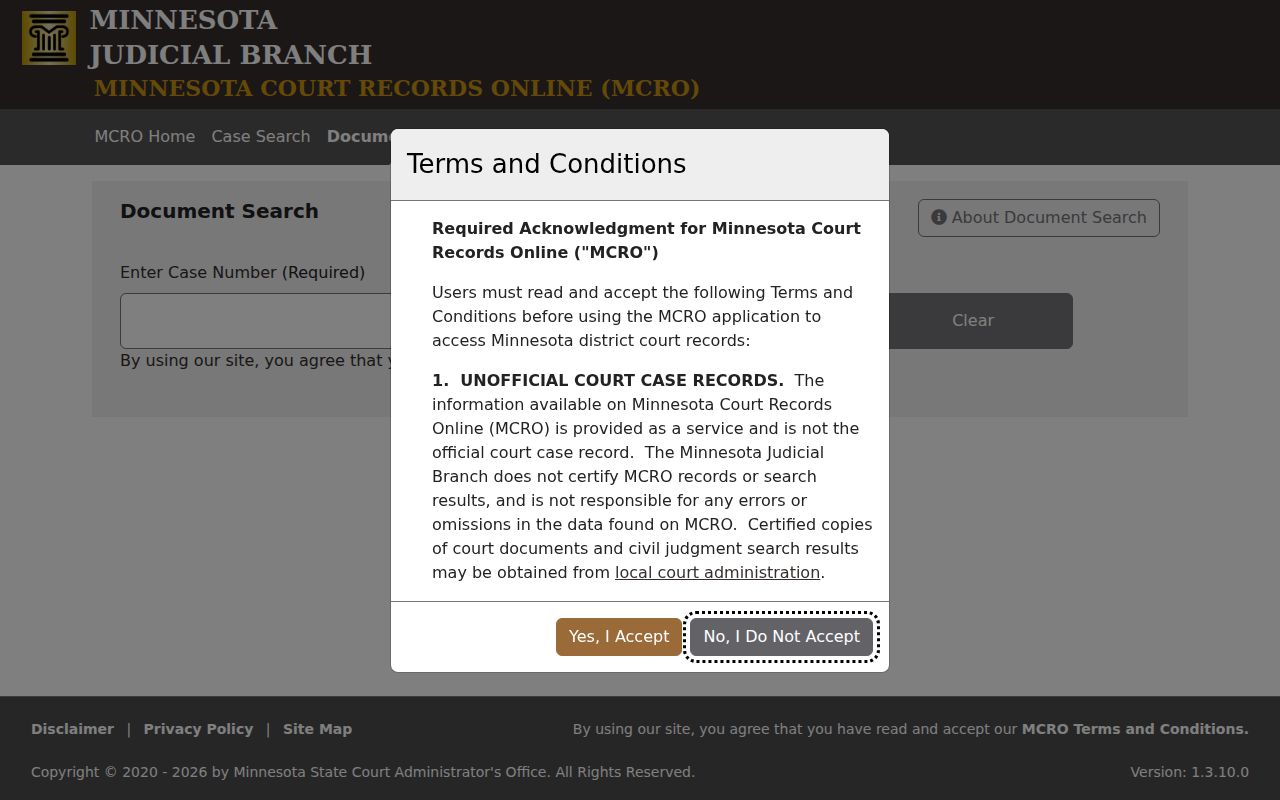
Already have a case number? MCRO Document Search is the route for it. It won't work as a general name search, though. The official MCRO Document Search page opens the portal and explains what it returns: documents designated for remote public access, delivered as unofficial, watermarked copies. One quirk worth knowing is that a case can show a public Register of Actions entry even when no document is available to download.
When a document doesn't appear in the remote results, the path shifts. Court Administration can point you to courthouse inspection, a terminal, or a copy request, subject to the applicable rule or order. The local court sits at 401 Carver Road, Mankato, MN 56001, open for court business from 8:00 a.m. to 4:30 p.m. on weekdays. The wider facility posts different hours for some departments. Check before you go for anything beyond court records.
Mailing a request? The official Minnesota copy-request guidance tells you what to describe. Name the case, the document, the date, or the index entry, plus your choice of copy type. The Fifth District statewide copy-request form lists the delivery options. It covers the details needed to match a file. Blue Earth County makes no fixed turnaround promise. Ask Court Administration about retrieval time rather than expecting a set completion date.
Blue Earth County Court Record Custodians
For the local District Court file, Blue Earth County Court Administration is the public-facing office to contact. It covers civil, criminal, family, probate, juvenile, conciliation, and traffic records, while MCRO supplies the remotely available public layer. That split matters. An online docket search can't always produce an older file, a certified copy, or a record that isn't shown remotely. Those gaps send you back to the clerk.
Other county offices hold related but separate material. The County Attorney keeps prosecutor complaint materials, and the Sheriff holds law-enforcement records. City offices keep municipal notices and administrative documents. A court calendar is different from the case record too. It lists scheduled hearings only, not the full run of filings and orders.
Types of Court Records
What's actually inside a Blue Earth County court file? It can include the Register of Actions, pleadings, motions, affidavits, notices, orders, judgments, returns of service, financial or accounting filings, exhibits, and transcripts. Contents vary with the case type, the filing date, and the access rules. Civil, criminal, family, probate, juvenile, conciliation, and traffic cases all run through the local District Court administration. They don't all get the same remote access.
- Register of Actions: the chronological record of case activity, filings, proceedings, and events.
- Pleadings and motions: submitted court documents that may or may not be remotely available.
- Orders and judgments: court actions that can resolve or direct part of a case.
- Hearing and calendar records: scheduled-setting information rather than a full case history.
- Probate and accounting filings: records that can have separate access boundaries.
- Transcripts and exhibits: distinct items with their own request or inspection process.
Conciliation Court handles small claims as a division of the district court, not as a separate municipal docket. Family and post-adjudication paternity files carry narrower remote document coverage than ordinary civil or criminal files. Juvenile and mental-health categories need extra care, since access can be limited even when a calendar or index shows a small amount of information.
Blue Earth County Record Types
Four different tools, four different jobs. The Register of Actions tells you what has already happened in a case file. The daily calendar shows only what is scheduled. Document Search can pull eligible downloadable files, and it works best when you already hold the case number. Judgment Search sits furthest from the full record. A Blue Earth County judgment search surfaces docketed monetary judgments and satisfactions, nothing more.
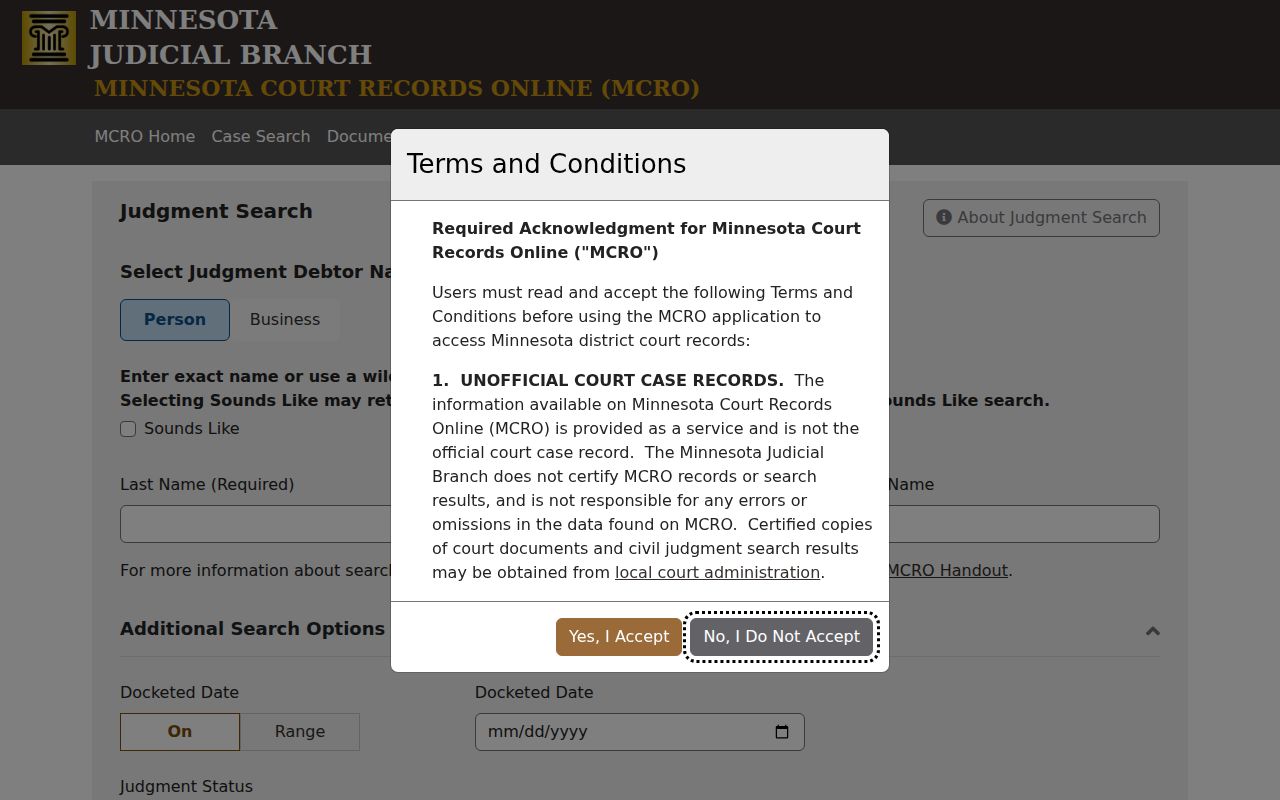
That narrowness cuts both ways. A calendar entry is not a result. A judgment-search hit will not show you every pleading sitting in the civil docket. When you want the whole court history of a case, the Register of Actions is the tool that delivers it. The official MCRO Judgment Search page, reflected here, supports a debtor-focused lookup by person or business, with controls for date, status, and court location. Use it for judgments. Use the Register of Actions for the story of the case.
Not every public record lives with the court. Complaint materials from the County Attorney are a separate filing, sheriff records stay in law enforcement hands, and city administrative notices belong to the city that issued them. Pick the office that actually holds the record you want. Sending a court docket request to an unrelated county office only slows it down.
What a Court Record Contains
A search result is not the whole case file. Every Blue Earth County case number packs in the county, the case type, the filing year, and a sequence number. Local cases start with 07, like 07-CV-26-#### or 07-PR-26-####. From that number, the Register of Actions links you to filed documents, hearings, orders, and whatever came later. What is actually in the file varies a lot. A document entry can also appear in the docket without any public PDF behind it.
| Case number | The local county, type, year, and sequence identifier used to locate the file. |
|---|---|
| Register of Actions | The docket-like record of activities, filings, and proceedings in the case. |
| Pleadings and motions | Filed requests and responses that may have access limits or no remote attachment. |
| Orders and judgments | Court-issued rulings or entered judgment information. |
| Document index | An event or document reference that can show an -Other label or unknown page count. |
| Exhibits or transcripts | Separate materials that may require court conditions or a court-reporter request. |
Seeing a document in the index does not mean you can open it online. Treat a missing page count, an index-only line, or an -Other label as portal metadata and nothing more. Guessing at contents from a label is a mistake. For a certified copy, go through Court Administration. An MCRO download carries no certification.
Blue Earth County Court Record Coverage
MCRO coverage is not uniform. The Judicial Branch posts broad remote coverage for documents filed after July 1, 2015 in major and minor criminal and civil cases, plus formal and other probate, guardianship, conservatorship, and trust cases. Older files are covered less fully. Family cases get the thinnest remote access: usually court-prepared orders, judgments, notices, and appellate opinions, not party-submitted documents.
Some matters stay off remote viewing entirely. Civil commitment, domestic abuse, harassment, juvenile, CHIPS, sealed, and expunged cases can all be missing. E-filing does not change this, because the access rule or a court order still controls what goes public. A Blue Earth County docket entry with a Register of Actions but no PDF means you should visit the courthouse terminal or ask Court Administration about inspecting or requesting an eligible public copy.
Note: A downloaded MCRO document is unofficial. Certification comes only through the court-administration copy process.
Certified Copies and Fees
Plain, certified, and exemplified are three different products. Under the current Judicial Branch copy-request guidance, plain or uncertified copies carry no fee. Certified copies run $14 per document. Exemplified copies run $14 per document as well. Certified plus exemplified copies run $28 per document. A multi-page certified document counts as one document on the form. Since fee schedules can change, confirm with the current source before you submit.
| Copy type | Current listed amount |
|---|---|
| Plain or uncertified copy | No fee on current copy-request guidance |
| Certified copy | $14 per document |
| Exemplified copy | $14 per document |
| Certified and exemplified copy | $28 per document |
| Inspection of accessible originals | Generally no fee; copying or special services can carry charges |
Filing fees and copy fees are two separate schedules. The Blue Earth district-court fee lookup lists local filing and related fees, including a Blue Earth law-library surcharge that applies to many items. For the right copy type and any local charge, Court Administration can confirm before you send a request.
Blue Earth County Court Administration
Blue Earth County Justice Center
401 Carver Road
Mankato, MN 56001
(507) 594-3055
Blue Earth County Court Record Requests
A strong request starts with details. Give the court file number, case type, document description, date, or index number. Pick Plain, Certified, or Certified and Exemplified. Say how many copies you want and how you want them delivered, and include payment. The Fifth District form permits U.S. mail, pickup, fax, email, or another prepaid carrier. Fax and email work only for plain nonconfidential copies. For a Blue Earth County filed case, Court Administration is the contact.
Mailed requests are not same-day service. Blue Earth posts no official turnaround time. It posts no general identification rule either, so plan for flexibility. An older paper file may need retrieving, and a restricted-record request may need extra paperwork. A transcript is different from a document copy altogether. Request it from the court reporter who recorded the hearing.
Keep the request tied to one case and one document. Court rules shield certain addresses and financial-account numbers. They also shield Social Security numbers and identifying details about jurors, witnesses, and victims. Needing to identify a file never licenses the broad release of those sensitive details.
Blue Earth County Court Record Delivery
How should your Blue Earth County court record arrive? The record type and request form decide. The Fifth District copy form offers U.S. mail, pickup, fax, email, and prepaid carrier, though fax and email are limited to plain, nonconfidential copies. Court Administration confirms which route fits. It can also say whether payment must travel with the request.
There is a second option. Accessible originals can be inspected during regular court hours under the public-access rules. That route may beat a remote copy when no certification is needed. A courthouse terminal works as another fallback. One limit stays firm: never use a delivery choice to skirt a sealed, confidential, juvenile, expunged, or court-ordered restriction.
Public Access and Sealed Records
Minnesota splits access into layers. Originals that are open to the public can usually be inspected where they are kept, during regular hours. Remote access through MCRO is narrower. A restriction can come from a statute, a court rule, a court order, expungement, or the case category itself. Court Administration can explain the process for a closed record, but it cannot turn a restricted record into a public online one.
The official Minnesota Rule of Public Access 8 sets out the inspection and copying rights, along with the limits that apply to remote access.
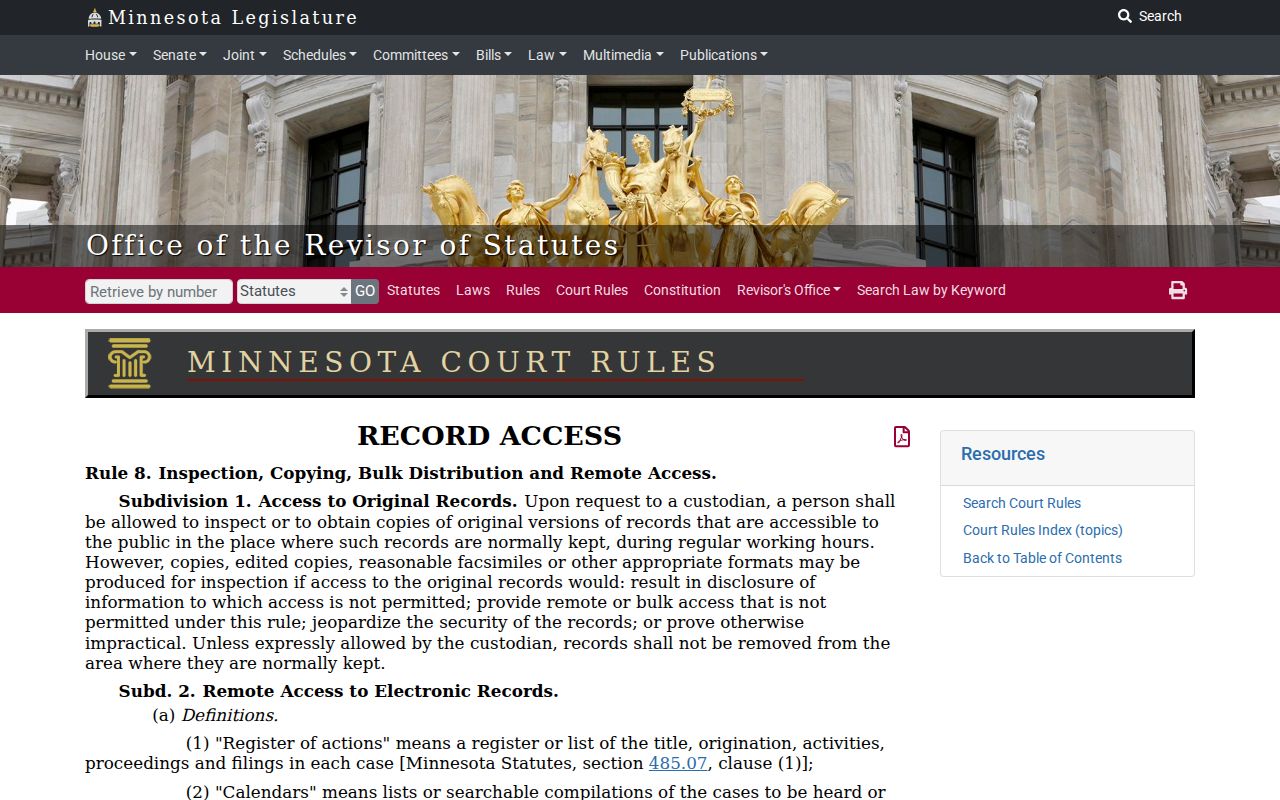
Rule 8 confines remote access to specified data and case categories. A name-search miss proves little. It does not show that no case exists. That is especially true for a pending criminal defendant search or a protected case type. The official Minnesota Rule of Public Access 4 builds the framework for records made inaccessible by rule, statute, or order.
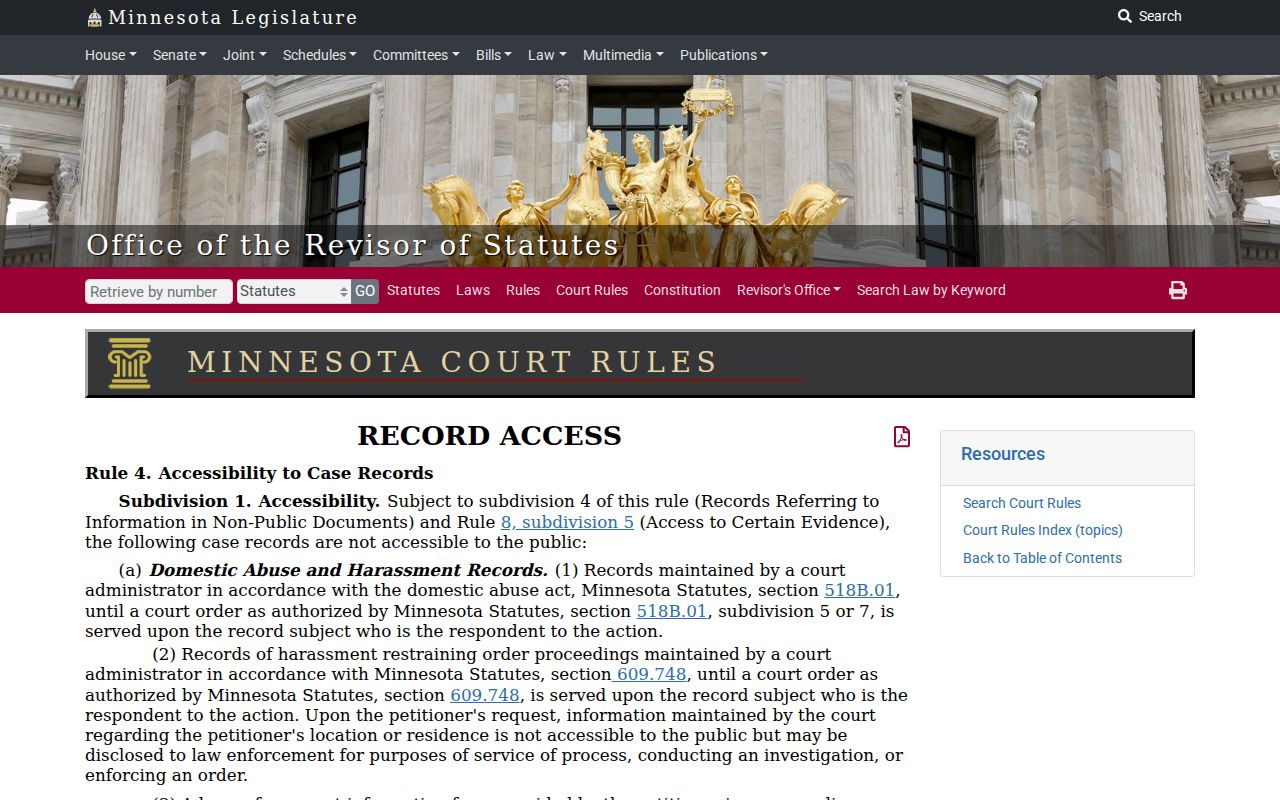
Rule 4 makes one more point. A restriction can attach to a single case alone, and email or fax delivery on a copy form does not override confidentiality.
Key Rules:
Minnesota Rule of Public Access 8 allows inspection and copying of accessible court records while limiting remote access to defined data and categories.
Minnesota Rule of Public Access 4 recognizes records made inaccessible by controlling rule, statute, or court order.
Minn. Stat. § 609A.01 treats expungement as a court-ordered sealing and nondisclosure remedy.
Minn. Stat. § 260B.163 establishes specialized public-access boundaries for juvenile proceedings and records.
Blue Earth County Transcript Records
A transcript is not a normal copy. The court reporter prepares it word for word from the hearing itself. A Register of Actions entry showing a hearing took place does not mean a transcript was ever prepared or filed. Ask the reporter who covered the hearing. Payment comes first. When the assigned reporter is unknown, Court Administration can supply that name or the proper local contact.
Costs follow a statewide Judicial Council policy. Page rates run $5.75 for several civil, family, probate, child-protection, and related categories, and $4.25 for criminal and juvenile categories, with added terms for expedited work. A filed transcript may surface in MCRO. The copy-request route can also produce one, though confidential material may call for a different process. Court Administration can name the right request channel. It will not promise a particular turnaround.
Blue Earth County Court Record Terminal
Do not treat the courthouse public-access terminal as a backup for a slow website. It is a genuine option. Some records sit open at the courthouse. The MCRO view can stay thin for several reasons. Age, case type, document designation, or a remote-access rule can all narrow it. The local court page posts no room number or terminal map. So ask Court Administration or courthouse security when you arrive.
Terminal access does not erase confidentiality limits that attach to the file. Rule 8 still governs accessible originals. The remote system also stays narrower than walking up and inspecting the file in person. A record that stays inaccessible may need a request with extra paperwork. It may need judicial permission, not a different internet search. Court Administration can describe the proper process without opening a restricted record.